


HUSK IT – Psyllium Husk Fiber Powder
HUSK IT – Psyllium Husk Fiber Powder
Couldn't load pickup availability
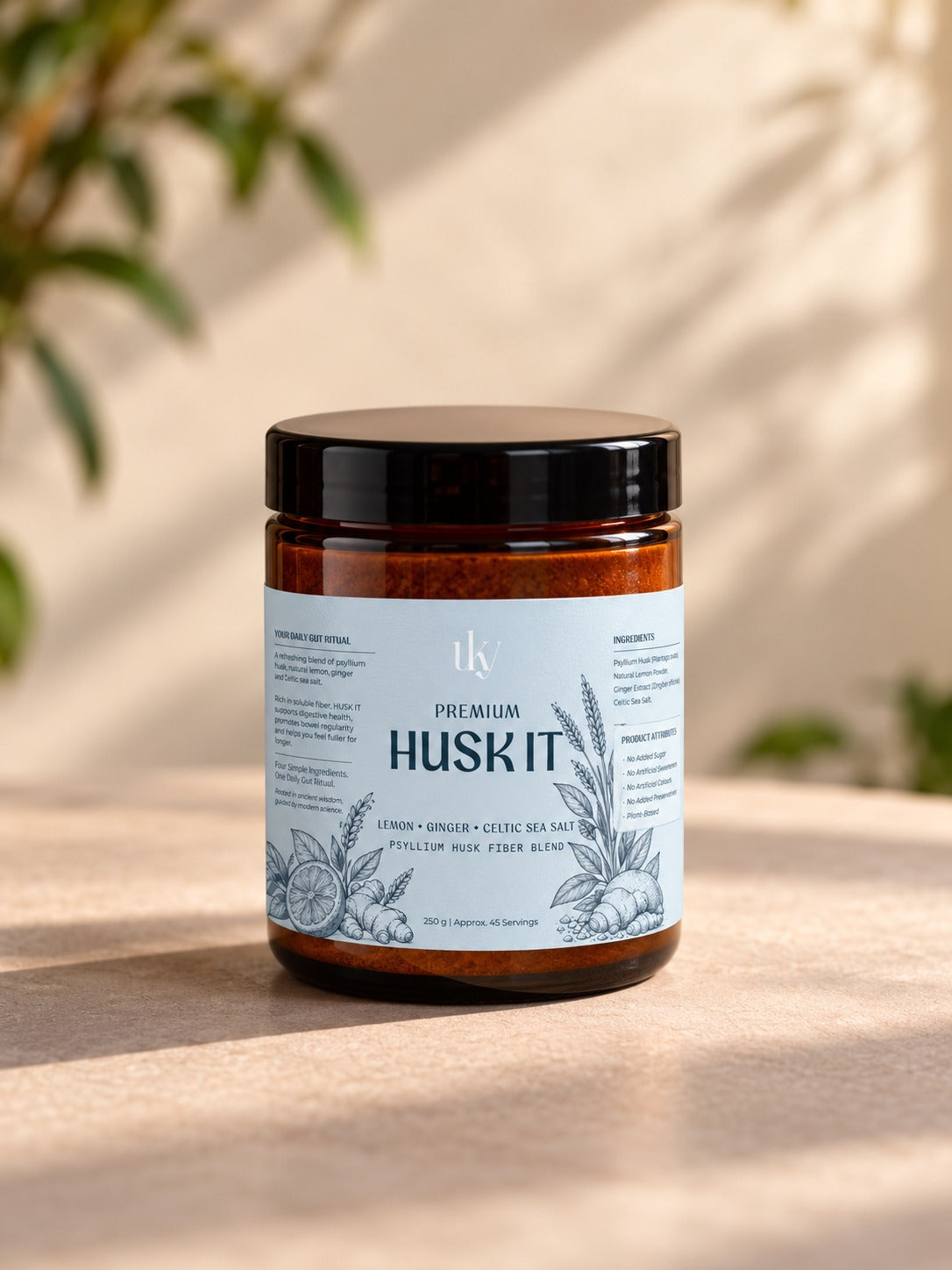
Most people know they need more fiber, but few enjoy getting it. Plain psyllium husk can taste bland and feel heavy. UKY HUSK IT was created to change that.
Each serving gives you 5 g of pure psyllium husk (Plantago ovata), a trusted natural source of soluble fiber. We've paired it with natural lemon powder for a fresh citrus taste, ginger extract for a gentle, warming kick, and Celtic sea salt to balance the flavour. The result is a clean, refreshing fiber drink you'll actually look forward to.
Why You'll Love It
Why You'll Love It
- Supports healthy digestion: Psyllium absorbs water and forms a gel-like consistency that supports stool formation.
- Promotes regularity: A simple daily habit for keeping things moving.
- Helps you feel full: Soluble fiber supports satiety, which is great alongside a balanced diet.
- Fresh lemon and ginger taste: Real lemon fruit powder, with no artificial lemon flavouring.
- Ginger for digestive comfort: A traditional botanical, standardized and food-grade.
- Balanced with Celtic sea salt: Just enough to round out the citrus and ginger flavours.
Easy to use: Mix, stir, drink. About 18 servings per jar.
How to Use Husk It
How to Use Husk It
- Pour 250 ml of water into a glass or shaker.
- Add one level scoop and stir or shake immediately.
- Drink straight away before the mixture thickens, while sitting upright.
- Follow with a second full glass of water.
Who Is It For?
Who Is It For?
Ideal for adults looking to increase their fibre intake, including those with low-fibre diets, busy desk-based routines, or frequent travel schedules.
Certificate of Traceability
Certificate of Traceability
1. Third-Party Heavy Metal Testing
Every product lot is independently tested for four heavy metals: arsenic, cadmium, lead and mercury to support quality and safety standards.
2. Non-GMO Project Verified
Verification confirms that the product is formulated with non-GMO ingredients.
3. Certified B Corporation
Evaluates a company’s impact across governance, workers, customers, community and the environment.
4. Product Carbon Footprint
Measures emissions across the product lifecycle, from ingredients and manufacturing to transportation, packaging, consumer use and end-of-life disposal.


Clinically Researched Ingredients With Real Results
-

CLEANSE
The gel-forming fiber that supports regularity and a clean, comfortable gut routine.
-

SOOTHE
A warming botanical traditionally used for digestive comfort.
-

REFRESH
Real lemon powder for a bright, zesty taste that makes daily fiber enjoyable.


Frequently Asked Questions
What does Husk It taste like?
Fresh and lightly citrusy, with a mild ginger warmth. Psyllium is thick by nature, so the drink has a slightly gel-like texture; drink it right after stirring.
When should I take it?
Husk It is built as a night-time routine: one level scoop in a full glass of water, taken sitting upright and followed by a second glass. Take it 2 hours apart from medication.
Can I take it every day?
Start with half a serving (2.5 g) for the first week, then move to one full serving (5 g) at night. Speak to your doctor first if you have a medical condition or take regular medication.
Why is there salt in it?
A small amount of Celtic sea salt improves flavor and adds a little sodium to support hydration. It contains about 52 mg of sodium per 5 g serving.
Does it contain sugar, sweeteners or caffeine?
While there are many products on the market, the best black seed oil is organic, 100% pure, and cold-pressed to preserve its naturally occurring compounds. Look for a formula that is made in a GMP-certified facility, tested in ISO-accredited labs, and is non-GMO
Does it contain sugar, sweeteners or caffeine?
No added sugar, no artificial sweeteners and no caffeine.
Is it vegan and gluten-free?
The ingredients are plant-based and naturally gluten-free. Confirm with your supplier and manufacturing facility before printing this on the label.
Can children or pregnant women use it?
Not without medical advice. Please ask a doctor first.
Backed by Clinical Trials

STUDY 1
Clinically studied for Constipation
A 2022 analysis of 16 trials ranked psyllium the most effective fiber at over 10 g a day for 4 weeks or more. In a 1998 trial of 170 people, 10 g a day softened hard stools by day 3, and a stoolsoftener drug did not. A 2021 review calls the effect modest, less than prunes, lactulose or PEG, but safe.

Study 2
Clinical study on Loose stools
Four small crossover trials (6 to 25 people) found psyllium firmed up loose stools by holding water in a gel. In 25 people with chronic diarrhea, 10 g a day with calcium halved stool frequency, like loperamide, with better stool consistency. Most trials used drug-induced diarrhea in healthy volunteers.

History of Psyllium Husk
1. Ancient Roots in South Asia
Psyllium husk comes from Plantago ovata, a small annual herb known as isabgol in India. Traditionally used in Ayurvedic and Unani medicine, it was valued for digestive concerns, including constipation and diarrhoea.
2. A Name Inspired by Nature
The word psyllium comes from the Greek word for “flea,” inspired by the tiny, flea-like appearance of its seeds. The English term dates back to approximately 1595–1605.
3. From Seed to Husk
Psyllium husk is obtained by milling the outer seed coat, which accounts for approximately 25% of the seed’s weight. India became the world's leading producer and exporter, with cultivation concentrated mainly in northern regions.
4. Tradition Meets Modern Science
Long valued as a gentle digestive remedy, psyllium is now recognised for its gel-forming soluble fibre. When mixed with water, it forms a gel that helps soften stools and support bowel regularity, with evidence supporting its use for both constipation and certain forms of diarrhoea.